The Trinity Controversy | Randy Skeete

This is interesting

EGW" Christ was the angel appointed of God to go before Moses in the wilderness, conducting the Israelites in their travels to the land of Canaan.—The Review and Herald, May 6, 1875. {TA 98.1}

and

EGW: "Christ was the angel who went before Moses, and guided the travels of the children of Israel in the wilderness. God had said to Israel, “Behold, I send an angel before thee, to keep thee in the way, and to bring thee into the place which I have prepared. Beware of him, and obey his voice, provoke him not; for he will not pardon your transgressions; for my name is in him. But if thou shalt indeed obey his voice, and do all that I speak, then I will be an enemy unto thine enemies, and an adversary unto thine adversaries.” Exodus 23:20-22. This angel, Christ, gave Moses the ceremonies and ordinances of the Jewish law to be repeated to the people. {RH April 29, 1875, par. 1}

and

EGW: "Christ was the angel appointed of God to go before Moses in the wilderness, conducting the Israelites in their travels to the land of Canaan. Christ gave Moses his special directions to be given to Israel. “Moreover, brethren, I would not that ye should be ignorant, how that all our fathers were under the cloud, and all passed through the sea; and were all baptized unto Moses in the cloud and in the sea; and did all eat the same spiritual meat; and did all drink the same spiritual drink; for they drank of that spiritual Rock that followed them; and that Rock was Christ.” {RH May 6, 1875, par. 8}

These are the ONLY three messages by EGW on this theme.

Does this make Christ an cherub? Or is she quoting the Bible without correcting the fuzzy translation?

Search ""Christ was the cherub" no results

Search "Christ cherub"~10 yields 24 results

EGW: Satan seems paralyzed as he beholds the glory and majesty of Christ. He who was once a covering cherub remembers whence he has fallen. A shining seraph, “son of the morning;” how changed, how degraded! From the council where once he was honored, he is forever excluded. He sees another now standing near to the Father, veiling His glory. He has seen the crown placed upon the head of Christ by an angel of lofty stature and majestic presence, and he knows that the exalted position of this angel might have been his. {DD 56.2}

This passage says Satan is a cherub and a saraph just as Jesus is a saraph but NOT a cherub.

EGW: "Christ had worked in the heavenly courts to convince Satan of his terrible error, till at last the evil one and his sympathizers were found in open rebellion against God Himself. Then he claimed a right to take a position above Christ as covering cherub. Expelled from heaven, he came to this earth, determined to work against Christ. He is in no danger of losing the angels that he deceived. He has them under his banner, enlisted to fight against the Son of God. {TDG 256.4}

I see no mention of Christ as a cherub.

EGW: "Speaking of Satan, our Lord says that “he abode not in the truth.” He was once the covering cherub, glorious in beauty and holiness. He was next to Christ in exaltation and character. It was with Satan that self-exaltation had its origin. He became jealous of Christ, and falsely accused him, and then laid blame upon the Father. He was envious of the position that was held by Christ and the Father, and he turned from his allegiance to the Commander of heaven and lost his high and holy estate. Though the angels had a knowledge of God and of Jesus Christ, though they were happy in the glorious service which they did for the King of heaven, yet, through his crooked representations of Christ and the Father, the evil one deceived a great company of angels, drew them into sympathy with himself, and associated them with himself in rebellion. Satan and his sympathizers became the avowed antagonists of God, established their own infernal empire, and set up a standard of rebellion against the God of heaven. All the principalities and powers of evil rallied to the work of overthrowing the government of God. {RH October 22, 1895, par. 1}

Again no mention of Christ as a cherub. Only a cherub getting jealous of Christ.

EGW: "The enemy is frequently working your mind. He has endeavored to implant in your mind the same desires that he cherished when in the heavenly courts he occupied the position of covering cherub. Christ is the express image of His Father’s person, and the angels could see in the Son a perfect representation of God. Lucifer coveted the honor and glory given to Christ. He became so self-exalted that he supposed that he could do anything he desired to do because of his high position as covering cherub, and he tried to obtain for himself the position given to Christ. But Lucifer fell. He was cast out of heaven; and now he works on human minds, tempting them to follow in his footsteps. He strives to fill minds with feelings of self-exaltation and to lead them to dishonor God by turning from their allegiance to the truth and inventing many things not after God’s order. {Lt55-1903.15}

Again no mention of CHrist as a cherub.

Polyglot you are misquoting and misleading readers with deception. You need to look up all the themes before making a summary.
I hope this clears up the matter for you. EGW is just quoting a fuzzy translation. Though it make also appear because Jesus worked with cherub a lot, he seemed to be one of them. Shalom

You said: "Christ was not an angel." That is what I was referencing. Perhaps in earlier discussions with someone else you were discussing cherubim. Please know that I have never posted here before signing up a day or so ago, so I am not a reincarnation of someone with whom you may have interacted here previously.

I have never said Christ was a cherub.

I will say, however, that "elohim" would include God, Christ/Jesus, Lucifer, Gabriel, cherubim, seraphim, false gods, and even judges or people. As difficult as it is for the English speaker to accept, this is the Hebrew reality.

Your remark that "EGW is just quoting a fuzzy translation" is a bit disturbing. Ellen White never quoted Bible verses which were unacceptable. For example, she never quoted 1 John 5:7-8. She informed us of errors in some places, such as that in Exodus 24:10-11 the elders of Israel had not seen the person of God, even though the KJV says they had seen God. She tells us that the word "sacrifice," connected to "the daily" in Daniel, had been added in man's wisdom and did not belong to the text. If Ellen White quoted a verse, we can safely assume it is acceptable just as it was worded. This does not mean it was necessarily "perfect." God's own language, she has told us, was not on trial in the writings of the Bible--for it is expressed in the faulty language of men.
 
Greetings Polyglot, since you are a JW coming to spend time with the SDA, show me a Bible verse that clearly states the Most High created a cherub and His one and only Son.

Is it my duty to correct every erroneous thing said about me? Jesus did not. However, lest you should say I have agreed by my silence, or that I have misled you by not protesting the errors you have published, I shall answer the doctrinal part of this, for it is important.

First, I do not believe that God has "one and only Son." John 1:12 would counter any such notion rather well, for indeed, God has many sons, and we can be among them.

Secondly, God's son is not "created": he is "begotten." If one uses the wrong terminology, one may very well be teaching or believing error. Words are important, and the word "begotten" is very important.

Christian parents do not say, for example, that they "created" their children. They know that their is an important distinction between creating and procreating. Words are important.
 
Ellen White "went here." You ask if God has preserved His word. Read the following statements from Ellen White, and then I would be interested in your own answer to the question.


My answer would be this: "every one of us needs to stand intelligently on the Word. We cannot afford to be careless, but we must have that simplicity of godliness that is a virtue to us. We must have it."

Intelligent minds are capable of accepting that the Bible is not error-free, and yet that it was still authored by holy men of God who were inspired to write as they did. By carefully comparing scripture with scripture, it is more than possible to avoid deception and stumbling on account of the errors which may be there. It is akin to taking a checksum on the text--it is nearly always possible to identify the anomalies by virtue of their incongruity with the rest of scripture.
What you show here is translation issues, not the premise you posed that the Bible is not inspired.

Do you know what you are presenting even?

Sure I believe there are errors in translation, just as you do, but you posed the idea that God cannot preserve His words, whereas I believe God can and did preserve His words.

You said ""every one of us needs to stand intelligently on the Word.

I agree. SO why did you say "There are zero "YHWH" written by Moses in Gen. 19:24. He would have written "YHW."

Such a statement means the very Hebrew letters is not preserved?? I can see why a JW biased view might do this,
just as some say Gen 1:1 has a missing alpha letter?

As I said : Is God able to preserve "His letters that make His Words" in Hebrew? If this is not true, there is no point in reading Hebrew at all - Sure I agree on a little typo occasionally, but you are reading Genesis 19:24 with bias...
 
You said: "Christ was not an angel." That is what I was referencing. Perhaps in earlier discussions with someone else you were discussing cherubim. Please know that I have never posted here before signing up a day or so ago, so I am not a reincarnation of someone with whom you may have interacted here previously.

I have never said Christ was a cherub.

I will say, however, that "elohim" would include God, Christ/Jesus, Lucifer, Gabriel, cherubim, seraphim, false gods, and even judges or people. As difficult as it is for the English speaker to accept, this is the Hebrew reality.

Your remark that "EGW is just quoting a fuzzy translation" is a bit disturbing. Ellen White never quoted Bible verses which were unacceptable. For example, she never quoted 1 John 5:7-8. She informed us of errors in some places, such as that in Exodus 24:10-11 the elders of Israel had not seen the person of God, even though the KJV says they had seen God. She tells us that the word "sacrifice," connected to "the daily" in Daniel, had been added in man's wisdom and did not belong to the text. If Ellen White quoted a verse, we can safely assume it is acceptable just as it was worded. This does not mean it was necessarily "perfect." God's own language, she has told us, was not on trial in the writings of the Bible--for it is expressed in the faulty language of men.
I see - so Jesus is a real Divine Son, not an cherub. Good I agree. Sorry if I read you wrong.
I have no problem with elohiym meaning what you present, on the whole of all contexts elohiym refers to what I term loosely a "family word meaning of power"

(1) Divine members function as a family
(2) Devil and his angels function as a group
(3) Judges function as many judges from a family of judges
(4) Moses was a member of family with Aaron and Miriam

SO all contexts fit with this theme picture.

You state: "Your remark that "EGW is just quoting a fuzzy translation" is a bit disturbing. Ellen White never quoted Bible verses which were unacceptable.

I am interested in why you think like this?

EGW: "In reply to this question Jesus told him that obedience to the commandments of God was necessary if he would obtain eternal life; and He quoted several of the commandments which show man’s duty to his fellow men.

She uses the term obedience to the commandments - for the Hebrew term "shamar mitsvah"

My question - why does GOD choose to use obey for "shamar" ?

EGW: "One thing thou lackest,” He said; “go thy way, sell whatsoever thou hast, and give to the poor, and thou shalt have treasure in heaven: and come, take up the cross, and follow Me.” 28 {CSA 14.6}

Why doesn't Jesus tell the man about faith in the moral law and how obedience comes by faith in the law, instead Jesus gives the man a human powered thing He knew the man could not do.

In other words Jesus presented to the man what the man knew already and live up to already as truth.
That is why I term this "fuzzy translations" because often we read Scripture as we read them and live up to the light we know presently - it is hard to read the Ancient Hebrew experiences because it is too deep for us.

EGW: "Christ, seeing into his character, loved him. Love for Christ was awakening in the ruler’s heart; for love begets love. Jesus longed to see him a co-worker with Him. He longed to make him like Himself, a mirror in which the likeness of God would be reflected. 29 {CSA 14.7

SO Jesus answers in the way the man currently understood, not about genuine faith, but in a way the man would understand

EGW: "“One thing thou lackest,” Jesus said. “If thou wilt be perfect, go and sell that thou hast, and give to the poor, and thou shalt have treasure in heaven: and come and follow Me.” Christ read the ruler’s heart. Only one thing he lacked, but that was a vital principle. He needed the love of God in the soul. This lack, unless supplied, would prove fatal to him; his whole nature would become corrupted. By indulgence, selfishness would strengthen. That he might receive the love of God, his supreme love of self must be surrendered.... {CSA 15.1}

Surrendered is a little clue to faith theme here, but Jesus presented only what the man could understand, human powered religion, he was not ready for a faith teaching.

EGW: "His claim that he had kept the law of God was a deception. He showed that riches were his idol. He could not keep the commandments of God while the world was first in his affections. He loved the gifts of God more than he loved the Giver....

Here EGW is speaking of faith and the faith principles in the moral law, but Jesus did not speak this to the young man.

DO you even understand that the moral law is based on faith?

Read my study of shamar and tell me what you think of this Hebrew word meaning?


EGW: "They prove that they have not yet learned the holy law of God, and the explanation of that law in the pure gospel given upon the Mount. The Lord calls for a cleansing process, a purging of the soul temple. {Ms 26, 1899, par. 30}

This is one of rare messages where GOD uses the term "process" for the Hebrew word "shamar"??

Shalom
 
Is it my duty to correct every erroneous thing said about me? Jesus did not. However, lest you should say I have agreed by my silence, or that I have misled you by not protesting the errors you have published, I shall answer the doctrinal part of this, for it is important.

First, I do not believe that God has "one and only Son." John 1:12 would counter any such notion rather well, for indeed, God has many sons, and we can be among them.

Secondly, God's son is not "created": he is "begotten." If one uses the wrong terminology, one may very well be teaching or believing error. Words are important, and the word "begotten" is very important.

Christian parents do not say, for example, that they "created" their children. They know that their is an important distinction between creating and procreating. Words are important.
Yes words are important, and the Hebrew behind "begotten" is "yalad" which I understand to mean "male-born"

Ge 5:4 And the days of Adam after he had begotten Seth (begotten - yalad)
Ps 2:7 ¶ I will declare the decree: the LORD hath said unto me, Thou art my Son; this day have I begotten thee. (begotten - yalad)

You state: "First, I do not believe that God has "one and only Son." John 1:12 would counter any such notion rather well, for indeed, God has many sons, and we can be among them.

John 1:12 has "ginomai teknon theos" theos is elohiym. Tekon is ben. But what is "genomai" in Hebrew?
Also the verse has "pisteuo" a faith word, so these people become "adopted as sons to Jesus by faith in His Name"
You have missed on reading the verse properly ?

I am referring to a different process to be a son, through "yalad" which means to be born literally -

You say Elohiym Most High has no "yachiyd" "bar" (notice I did not use ben)

Ge 22:2 And he said <'amar>, Take now <laqach> thy son <ben>, thine only <yachiyd> son Isaac
Ge 22:16.. withheld <chasak> thy son <ben>, thine only <yachiyd> son:

These verses parallel that the Most High has a "yachiyd" "ben" or "bar"

Ps 22:20 Deliver <natsal> my soul <nephesh> from the sword <chereb>; my darling <yachiyd> from the power <yad> of the dog <keleb>.

This verse speaking of Yashah dying on the Cross is in fact a "yachiyd"

Jer 6:26 O daughter <bath> of my people <`am>, gird <chagar> thee with sackcloth <saq>, and wallow <palash> thyself in ashes <'epher>: make <`asah> thee mourning <'ebel>, as for an only son <yachiyd>,

Again a parallel to Israel mourning over a yachiyd

Zec 12:10...and they shall mourn <micepd> for him, as one mourneth <caphad> for his only <yachiyd>

So while you can doubt, I find these verses speak of the Most High having a yachyid

Shalom
 
What you show here is translation issues, not the premise you posed that the Bible is not inspired.
I do not appreciate the misrepresentations of my statements. I never once said the Bible was not inspired. You inferred this without it even being implied.

If I were to apply what appears to be your own logic on inspiration to the writings of Ellen White, I would have to say that she was not inspired either. She spoke very negatively of "conservative" people, and spoke positively of the liberals. But, both of those words had entirely different meanings in her day than they do in ours, only a century-plus away in time.

Languages evolve.

Did you know that the Hebrew niqqud (vowel markings) and te'amim (cantillation marks) were only added to the text starting about AD 500, well after the Bible was written?

Did you know that Greek lowercase letters did not exist until over a thousand years after the Bible was written?

What I have said remains true, and has nothing to do with the inspiration of the Bible. The Hebrew language evolved over the thousands of years during which the Hebrew Scriptures were being written. In Moses' time, there were no "matres lectionis" in the writing system. This is the reason that Moses consistently wrote "YHW" instead of "YHWH." That final "heh" was added to the spelling around the time of David.

The "heh" in Hebrew serves multiple purposes. It can represent a definite article when it precedes a noun or adjective. It can represent the start of a question within a sentence. It can follow a word as a directional "heh," implying "towards." It can have other uses, depending on the morphology and context of a word. Because Hebrew was not originally written with spaces between words, the ambiguity can present parsing challenges for readers and translators. One might need to ask whether the "heh" should be understood as a suffix to a word or as the prefix to the following word. The answer to this might make a huge difference to the meaning and grammar of the expression. Huge.

This is why virtually all translations of Exodus 6:3 get it wrong--they fail to account for the fact that Moses did not write "YHWH." They assume that scribes later added the final "H" to the word during copying, as the spelling had evolved. But this mistake in translation should be discernible on account of the fact that in Genesis Abraham names a place after God's name, clearly demonstrating that he did indeed know God's name. The "heh" in Exd. 6:3 should not be part of "YHWH": rather, it should be an interrogative "heh," attached to the following word at the start of the question. Instead of God telling Moses that the patriarchs had not known His name, God is challenging Moses, saying, "Did they not know me by my name?" The change from a statement to a question, all based on a single Hebrew letter, turns the verse to an opposite meaning. That's how important that letter is. And for translators, it is important to understand that the Hebrew language evolved before they will grasp the significance of that letter in the verse.

While much of this is tangential to the topic of this thread, I find it ironic that much of the Trinity controversy stems directly from ignorance of the Hebrew language. Our pastors are frequently presenting untruths about the Hebrew, knowing that the members at large do not know enough to be able to say otherwise. Particularly is this the case with words like "elohim" and the study of texts like Genesis 1:1, 26-27. These verses, understood correctly, would defeat the Trinity dogma rather than support it.

Ellen White in the book "The Great Controversy" has warned us away from accepting a "thus saith the church" or a "thus saith the pastor." She tells us plainly that Satan will use the pastors to mislead the people. When we allow the theologians to do our thinking for us, we submit to such deceptions as they will feed us.

I don't envy them. Ezekiel 9 will be literally fulfilled.
 
I do not appreciate the misrepresentations of my statements. I never once said the Bible was not inspired. You inferred this without it even being implied.

If I were to apply what appears to be your own logic on inspiration to the writings of Ellen White, I would have to say that she was not inspired either. She spoke very negatively of "conservative" people, and spoke positively of the liberals. But, both of those words had entirely different meanings in her day than they do in ours, only a century-plus away in time.

Languages evolve.

Did you know that the Hebrew niqqud (vowel markings) and te'amim (cantillation marks) were only added to the text starting about AD 500, well after the Bible was written?

Did you know that Greek lowercase letters did not exist until over a thousand years after the Bible was written?

What I have said remains true, and has nothing to do with the inspiration of the Bible. The Hebrew language evolved over the thousands of years during which the Hebrew Scriptures were being written. In Moses' time, there were no "matres lectionis" in the writing system. This is the reason that Moses consistently wrote "YHW" instead of "YHWH." That final "heh" was added to the spelling around the time of David.

The "heh" in Hebrew serves multiple purposes. It can represent a definite article when it precedes a noun or adjective. It can represent the start of a question within a sentence. It can follow a word as a directional "heh," implying "towards." It can have other uses, depending on the morphology and context of a word. Because Hebrew was not originally written with spaces between words, the ambiguity can present parsing challenges for readers and translators. One might need to ask whether the "heh" should be understood as a suffix to a word or as the prefix to the following word. The answer to this might make a huge difference to the meaning and grammar of the expression. Huge.

This is why virtually all translations of Exodus 6:3 get it wrong--they fail to account for the fact that Moses did not write "YHWH." They assume that scribes later added the final "H" to the word during copying, as the spelling had evolved. But this mistake in translation should be discernible on account of the fact that in Genesis Abraham names a place after God's name, clearly demonstrating that he did indeed know God's name. The "heh" in Exd. 6:3 should not be part of "YHWH": rather, it should be an interrogative "heh," attached to the following word at the start of the question. Instead of God telling Moses that the patriarchs had not known His name, God is challenging Moses, saying, "Did they not know me by my name?" The change from a statement to a question, all based on a single Hebrew letter, turns the verse to an opposite meaning. That's how important that letter is. And for translators, it is important to understand that the Hebrew language evolved before they will grasp the significance of that letter in the verse.

While much of this is tangential to the topic of this thread, I find it ironic that much of the Trinity controversy stems directly from ignorance of the Hebrew language. Our pastors are frequently presenting untruths about the Hebrew, knowing that the members at large do not know enough to be able to say otherwise. Particularly is this the case with words like "elohim" and the study of texts like Genesis 1:1, 26-27. These verses, understood correctly, would defeat the Trinity dogma rather than support it.

Ellen White in the book "The Great Controversy" has warned us away from accepting a "thus saith the church" or a "thus saith the pastor." She tells us plainly that Satan will use the pastors to mislead the people. When we allow the theologians to do our thinking for us, we submit to such deceptions as they will feed us.

I don't envy them. Ezekiel 9 will be literally fulfilled.
You write well Polyglot. But I am not familiar with this material. Changing the letters of Ancient Hebrew is a big deal to me and very much affects the inspiration of words based on letters. So how does this change in the YHW affect your theories of faith?
 
I do not appreciate the misrepresentations of my statements. I never once said the Bible was not inspired. You inferred this without it even being implied.

If I were to apply what appears to be your own logic on inspiration to the writings of Ellen White, I would have to say that she was not inspired either. She spoke very negatively of "conservative" people, and spoke positively of the liberals. But, both of those words had entirely different meanings in her day than they do in ours, only a century-plus away in time.

Languages evolve.

Did you know that the Hebrew niqqud (vowel markings) and te'amim (cantillation marks) were only added to the text starting about AD 500, well after the Bible was written?

Did you know that Greek lowercase letters did not exist until over a thousand years after the Bible was written?

What I have said remains true, and has nothing to do with the inspiration of the Bible. The Hebrew language evolved over the thousands of years during which the Hebrew Scriptures were being written. In Moses' time, there were no "matres lectionis" in the writing system. This is the reason that Moses consistently wrote "YHW" instead of "YHWH." That final "heh" was added to the spelling around the time of David.

The "heh" in Hebrew serves multiple purposes. It can represent a definite article when it precedes a noun or adjective. It can represent the start of a question within a sentence. It can follow a word as a directional "heh," implying "towards." It can have other uses, depending on the morphology and context of a word. Because Hebrew was not originally written with spaces between words, the ambiguity can present parsing challenges for readers and translators. One might need to ask whether the "heh" should be understood as a suffix to a word or as the prefix to the following word. The answer to this might make a huge difference to the meaning and grammar of the expression. Huge.

This is why virtually all translations of Exodus 6:3 get it wrong--they fail to account for the fact that Moses did not write "YHWH." They assume that scribes later added the final "H" to the word during copying, as the spelling had evolved. But this mistake in translation should be discernible on account of the fact that in Genesis Abraham names a place after God's name, clearly demonstrating that he did indeed know God's name. The "heh" in Exd. 6:3 should not be part of "YHWH": rather, it should be an interrogative "heh," attached to the following word at the start of the question. Instead of God telling Moses that the patriarchs had not known His name, God is challenging Moses, saying, "Did they not know me by my name?" The change from a statement to a question, all based on a single Hebrew letter, turns the verse to an opposite meaning. That's how important that letter is. And for translators, it is important to understand that the Hebrew language evolved before they will grasp the significance of that letter in the verse.

While much of this is tangential to the topic of this thread, I find it ironic that much of the Trinity controversy stems directly from ignorance of the Hebrew language. Our pastors are frequently presenting untruths about the Hebrew, knowing that the members at large do not know enough to be able to say otherwise. Particularly is this the case with words like "elohim" and the study of texts like Genesis 1:1, 26-27. These verses, understood correctly, would defeat the Trinity dogma rather than support it.

Ellen White in the book "The Great Controversy" has warned us away from accepting a "thus saith the church" or a "thus saith the pastor." She tells us plainly that Satan will use the pastors to mislead the people. When we allow the theologians to do our thinking for us, we submit to such deceptions as they will feed us.

I don't envy them. Ezekiel 9 will be literally fulfilled.
You introduced too much information Polyglot and caught me off guard and overwhelmed. Sorry.
I have tried to find some paleo-hebrew fragments with interlinear English translations of the letters and words - without success - the topic is very much recent and much of the scholars do not help much.

DO you have any links to pictures of Paleo-Hebrew with interlinear English translations over the top of the pictures ? Most I find is lots of text, no pictures and no scholars willing to teach in simple terms? Shalom
 
PaleoHebrew1.png

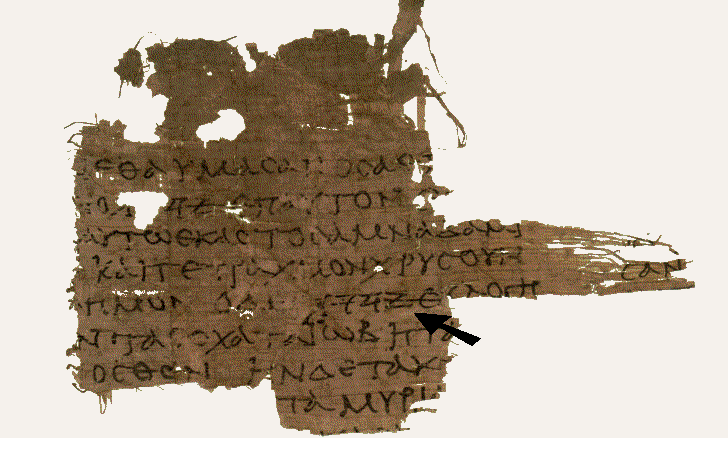
Polyglot, here is a picture of Job 42 showing the YHWH in the black arrow.

It is hard to find scholars allowing you to read the Paleo Hebrew letter by letter or word by word.
Does this picture show spaces between words ? Dunno
The manuscript is about 200BC.

Shalom
 
You write well Polyglot. But I am not familiar with this material. Changing the letters of Ancient Hebrew is a big deal to me and very much affects the inspiration of words based on letters. So how does this change in the YHW affect your theories of faith?
I don't reckon it makes any change to my faith, no more than the change from the English "Saviour" to the American "Savior" makes for me. Ellen White used both forms. Ask her, or God, for the reason.

Inspiration is not language-specific. God can inspire in Hebrew, Aramaic, Greek, or English as He chooses. The writer must transfer the inspired thought to his or her own language--and it may not even be always letter-perfect in terms of accuracy, spelling, or grammar. Inspiration is not God's pen: it is His thought.

You introduced too much information Polyglot and caught me off guard and overwhelmed. Sorry.
I have tried to find some paleo-hebrew fragments with interlinear English translations of the letters and words - without success - the topic is very much recent and much of the scholars do not help much.

DO you have any links to pictures of Paleo-Hebrew with interlinear English translations over the top of the pictures ? Most I find is lots of text, no pictures and no scholars willing to teach in simple terms? Shalom
I do not know of any pictures of the Hebrew manuscripts which would have English superimposed on them. My search would likely come up as empty as yours. But if you look online for text that supports what I have said, you should be able to find it. My studies in Hebrew have largely come from Jewish speakers of Modern Hebrew who presently reside in Israel. They have taught some of how the Hebrew language evolved as understood from extra-biblical texts including those of sister languages like Aramaic, Ugaritic, Phoenician, etc. It is widely known that the matres lectionis characters, which included the "heh", "vav", and "yod", did not come into usage in the language until the times of the kings of Israel. Prior to this, any time they were written they were strictly consonants and not vowels.

English has a similar phenomenon. When I was a pre-schooler I learned a little ditty that said "The names of the vowels are A, E, I, O, U, and sometimes Y." We all know that "Y" can be either vowel or consonant in English. But one I did not then learn, and only later realized as a linguist analyzing my own language, is that the letter "W" is also sometimes a consonant and sometimes a vowel. Consider the word "willow," for example, which has both forms--the first occurrence being a consonant and the latter being a vowel. The Tetragrammaton is like this: the first "heh" in it is consonantal, whereas the last one is a vowel.

As relates to modern "faith" issues, the importance of the addition of that vowel is that it is a clear record that as of the time of this addition, people were pronouncing God's name. It was about the first century BC when the name was declared ineffable, and never to be pronounced. This is the reason the Jews substituted the "adonai", meaning "Lord", in place of saying the sacred name. The KJV translation followed this tradition by substituting "LORD", in all-caps, wherever the Tetragrammaton appeared--and in dozens of places even beyond that, unfortunately.

Jews today will claim that no one knows how to pronounce God's name, as it has not been said for over two thousand years. But most scholars today see "Yahweh" as the most likely pronunciation--a word which did not even exist in the dictionaries of Ellen White's day, so she used the best available in her time which was "Jehovah," an amalgamated word created by pronouncing the YHWH consonants by the vowels for "adonai"--vowels which the Masoretes added to remind the reader to say "adonai" in place of pronouncing the actual name.
PaleoHebrew1.png

Polyglot, here is a picture of Job 42 showing the YHWH in the black arrow.

It is hard to find scholars allowing you to read the Paleo Hebrew letter by letter or word by word.
Does this picture show spaces between words ? Dunno
The manuscript is about 200BC.

Shalom
By 200 BC the added vowels had already entered the language, and scribes copying the text would have been spelling the name that way. I do not presently have time to address this more...perhaps later.
 
Last edited:
Your a good friend Polyglot, thanks for your scholarship and help in Hebrew language. I appreciate your views.
Perhaps we can share some more, when you are ready? God bless.
 
Greetings Polyglot

In one of my remarks, I said Jesus was not an angel, meaning cherub.
You state Jesus was an angel,

Than you post

EGW:" Christ was the angel who went before Moses, and guided the travels of the children of Israel in the wilderness. God had said to Israel, “Behold, I send an angel before thee, to keep thee in the way, and to bring thee into the place which I have prepared. Beware of him, and obey his voice, provoke him not; for he will not pardon your transgressions; for my name is in him.

But you agree Jesus is not a cherub.

Can you care to comment. Also regarding my use of "fuzzy translations" - here EGW is quoting the Bible in KJV which uses "angel" for "malak" instead of "messenger" and EGW does not correct the mistake in the KJV - uses "angel" as the translation shows.

Why doesn't EGW show Jesus is functioning as a messenger? Otherwise how can Jesus be an angel but not be a cherub?

EGW: "To all people, rich and poor, free and bond, Christ, the Messenger of the Covenant, brought the tidings of salvation. How the people flocked to Him!... {CH 318.2}

EGW: "Christ, the royal messenger, came to John when on his sea-bound isle, and gave him the most wonderful revelations of Himself.—The Signs of the Times, March 3, 1890. {TA 243.1

EGW: "The patriarch now knew that he had been in conflict with a heavenly messenger. This was why his almost superhuman effort had not gained the victory. It was Christ, “the angel of the covenant.” Jacob was now disabled and suffering the keenest pain, but he would not loosen his hold. Penitent and broken, he clung to the Angel; “he wept, and made supplication,” pleading for a blessing. He must have the assurance that his sin was pardoned. The Angel urged, “Let Me go, for the day breaketh”; but Jacob answered, “I will not let Thee go, except Thou bless me.” His was the assurance of one who confesses his unworthiness yet trusts the faithfulness of a covenant-keeping God. {EP 128.5}

This is a good example of a fuzzy translation and how EGW corrects it without making simple readers discouraged over poor translations of the KJV. She uses the term "angel" to mean "messenger" but does not attempt to belittle the KJV,

Shalom
 
PaleoHebrew1.png

Polyglot, here is a picture of Job 42 showing the YHWH in the black arrow.

It is hard to find scholars allowing you to read the Paleo Hebrew letter by letter or word by word.
Does this picture show spaces between words ? Dunno
The manuscript is about 200BC.

Shalom
Juat a quick addition to this and will have to run again. The Tetragrammaton in that image is not in the same script as the rest of the text in the image. Scribes developed such reverence for the "sacred name" that they began having a special scribe who would write that name, while the other copyist would write everything else, leaving a blank for that name for the special scribe to fill in. This manuscript shows evidence for this practice. There are some manuscripts which still have the blanks, unfilled, which also give evidence for it. I will try to link an image I found online of the Tetragrammaton in various forms which you may compare to the above, but it appears to me to be the second form, whereas the bottom line shows the Hebrew form which the rest of the text in the Job manuscript appears written in. See below. Note that I have learned about this in my classes, but I have forgotten the names of these earlier script types--Phoenician or Paleo-Hebrew, perhaps? We study Biblical Hebrew using something like a Royal Aramaic font--like the last example in the image below.

Ufm3WSrczCZqS-2iumq51xzW-KgiSOR3GsgJ32x9aT6QoyexoEXsxZmyVqXAuWycH5FiNNItPt8KpnOhama5uA.webp
 
Greetings Polyglot

In one of my remarks, I said Jesus was not an angel, meaning cherub.
You state Jesus was an angel,

Than you post

EGW:" Christ was the angel who went before Moses, and guided the travels of the children of Israel in the wilderness. God had said to Israel, “Behold, I send an angel before thee, to keep thee in the way, and to bring thee into the place which I have prepared. Beware of him, and obey his voice, provoke him not; for he will not pardon your transgressions; for my name is in him.

But you agree Jesus is not a cherub.

Can you care to comment. Also regarding my use of "fuzzy translations" - here EGW is quoting the Bible in KJV which uses "angel" for "malak" instead of "messenger" and EGW does not correct the mistake in the KJV - uses "angel" as the translation shows.

Why doesn't EGW show Jesus is functioning as a messenger? Otherwise how can Jesus be an angel but not be a cherub?

EGW: "To all people, rich and poor, free and bond, Christ, the Messenger of the Covenant, brought the tidings of salvation. How the people flocked to Him!... {CH 318.2}

EGW: "Christ, the royal messenger, came to John when on his sea-bound isle, and gave him the most wonderful revelations of Himself.—The Signs of the Times, March 3, 1890. {TA 243.1

EGW: "The patriarch now knew that he had been in conflict with a heavenly messenger. This was why his almost superhuman effort had not gained the victory. It was Christ, “the angel of the covenant.” Jacob was now disabled and suffering the keenest pain, but he would not loosen his hold. Penitent and broken, he clung to the Angel; “he wept, and made supplication,” pleading for a blessing. He must have the assurance that his sin was pardoned. The Angel urged, “Let Me go, for the day breaketh”; but Jacob answered, “I will not let Thee go, except Thou bless me.” His was the assurance of one who confesses his unworthiness yet trusts the faithfulness of a covenant-keeping God. {EP 128.5}

This is a good example of a fuzzy translation and how EGW corrects it without making simple readers discouraged over poor translations of the KJV. She uses the term "angel" to mean "messenger" but does not attempt to belittle the KJV,

Shalom
Your "fuzzy translation" in this case is an English problem, perhaps, but is not a Hebrew problem. In Hebrew, "malak" means "messenger." When it is a messenger from Heaven, we English speakers generally prefer the word "angel." Both are correct. Here is an example:

"But the angel of the LORD said to Elijah the Tishbite, Arise, go up to meet the messengers of the king of Samaria, and say unto them, Is it not because there is not a God in Israel, that ye go to enquire of Baalzebub the god of Ekron?" (2 Kings 1:3, KJV)

In this verse, both "angel" and "messengers" come from the same Hebrew root: Strong's number H4397. It is likely that the majority of English translations will translate the two occurrences of this Hebrew word in this verse to different English words based on the fact that one clearly applies to a divine being while the other to human beings. I suppose one could say we are biased against ourselves, and do not wish to be thought of as angels. Or perhaps we are elevating the divine, heavenly angels and consider the word "messenger" too low for them. Ultimately, it is really an issue with our mindset, differentiating between heavenly beings and earthly beings whereas the Hebrew does not do so in this case.
 
Juat a quick addition to this and will have to run again. The Tetragrammaton in that image is not in the same script as the rest of the text in the image. Scribes developed such reverence for the "sacred name" that they began having a special scribe who would write that name, while the other copyist would write everything else, leaving a blank for that name for the special scribe to fill in. This manuscript shows evidence for this practice. There are some manuscripts which still have the blanks, unfilled, which also give evidence for it. I will try to link an image I found online of the Tetragrammaton in various forms which you may compare to the above, but it appears to me to be the second form, whereas the bottom line shows the Hebrew form which the rest of the text in the Job manuscript appears written in. See below. Note that I have learned about this in my classes, but I have forgotten the names of these earlier script types--Phoenician or Paleo-Hebrew, perhaps? We study Biblical Hebrew using something like a Royal Aramaic font--like the last example in the image below.

Ufm3WSrczCZqS-2iumq51xzW-KgiSOR3GsgJ32x9aT6QoyexoEXsxZmyVqXAuWycH5FiNNItPt8KpnOhama5uA.webp
I see Polyglot, can I see the missing blanks please. Than this doesn't change the overall text, with YHW or YHWH it only is a blank space for the 3 letters or 4 letters, the rest of the letters as words is inspired and God's word is preserved. I see.
I get the impression the Phoenicians and the Samaritans books of Moses are possibly the best for accuracy? AND THIS MEANS the Paleo Hebrew is the original language Moses wrote and used. As you show in your image here. Again thanks for the info.
 
Your "fuzzy translation" in this case is an English problem, perhaps, but is not a Hebrew problem. In Hebrew, "malak" means "messenger." When it is a messenger from Heaven, we English speakers generally prefer the word "angel." Both are correct. Here is an example:

"But the angel of the LORD said to Elijah the Tishbite, Arise, go up to meet the messengers of the king of Samaria, and say unto them, Is it not because there is not a God in Israel, that ye go to enquire of Baalzebub the god of Ekron?" (2 Kings 1:3, KJV)

In this verse, both "angel" and "messengers" come from the same Hebrew root: Strong's number H4397. It is likely that the majority of English translations will translate the two occurrences of this Hebrew word in this verse to different English words based on the fact that one clearly applies to a divine being while the other to human beings. I suppose one could say we are biased against ourselves, and do not wish to be thought of as angels. Or perhaps we are elevating the divine, heavenly angels and consider the word "messenger" too low for them. Ultimately, it is really an issue with our mindset, differentiating between heavenly beings and earthly beings whereas the Hebrew does not do so in this case.
Nice reply Polyglot, I like your wisdom on this. But still I have never seen EGW correct fuzzy translations from the KJV.
When you seek why she preferred one translation over another, I find it uncanny she uses the best Ancient Hebrew rendering into English she finds. I call her my Hebrew English translation and this is why she was called for the end of time. She allows us to read the Hebrew messages with total and perfect clarity. But I find she is not easy to study and often her messages are hidden. I would prefer the word rendered as messenger for all contexts of "malak" and leave the translation nuances to the reader. That way we can be absolutely certain of the Hebrew translated consistently without bias.

For example this verse is always translated wrong...

Ge 1:5 And God called the light Day, and the darkness he called Night. And the evening and the morning were the first day.

The word "first" requires some time to compare it to, but there was none. The Hebrew says

Ge 1:5 And God called the light Day, and the darkness he called Night. And the evening and the morning were day one.

Now time begins on the frozen water ball for our creation reference for the first time. Before that time was not measured.
Now time is measured from this creation.

Evolution speaks of earth formed from a big bang out of chaos. I find this incorrect. The earth was formless and void because the Most High left the sinning angels on earth to themselves without God's presence, the earth plunged itself to 4 degrees Kelvin.
Jesus comes to renew the earth with a finely tuned creation that includes function and dysfunction. The darkness used is a simile of sin.

Ac 26:18 To open their eyes, and to turn them from darkness to light, and from the power of Satan unto God,

As this word shows in Hebrew as "choshek", so the earth begins in "darkness" a simile of sin, and time turns into the light from day one. The remake over is specially designed for a witness against the opposer. My two pennies listening to Walter Veith on some lecturers. Shalom
 
You said: "Christ was not an angel." That is what I was referencing. Perhaps in earlier discussions with someone else you were discussing cherubim. Please know that I have never posted here before signing up a day or so ago, so I am not a reincarnation of someone with whom you may have interacted here previously.

I have never said Christ was a cherub.

I will say, however, that "elohim" would include God, Christ/Jesus, Lucifer, Gabriel, cherubim, seraphim, false gods, and even judges or people. As difficult as it is for the English speaker to accept, this is the Hebrew reality.

Your remark that "EGW is just quoting a fuzzy translation" is a bit disturbing. Ellen White never quoted Bible verses which were unacceptable. For example, she never quoted 1 John 5:7-8. She informed us of errors in some places, such as that in Exodus 24:10-11 the elders of Israel had not seen the person of God, even though the KJV says they had seen God. She tells us that the word "sacrifice," connected to "the daily" in Daniel, had been added in man's wisdom and did not belong to the text. If Ellen White quoted a verse, we can safely assume it is acceptable just as it was worded. This does not mean it was necessarily "perfect." God's own language, she has told us, was not on trial in the writings of the Bible--for it is expressed in the faulty language of men.
You write well here Polyglot, so you find my term "fuzzy translation" a bit disturbing, yet you say we can assume the verses she used in not necessarily "perfect" - so the message comes in the faulty language of men. Arn't you on the same page as me? What English word would you use than, if you don't like "fuzzy translation"? The translation is a word meaning to interpret a word from one culture to another culture as perfectly as you can so the word meaning is correct from one culture to another culture. This is a difficult task. The adjective "fuzzy" refers to the "imperfect" task of rendering a translation perfectly.

Here is an example of Hebrew read by Hebrew readers, so Jesus has to translate the Hebrew for them because the Hebrew they were reading is fuzzy.

Lu 24:27 And beginning at Moses and all the prophets, he "translated" unto them in all the scriptures the things concerning himself.

This is the same word Paul uses here:

1Co 14:5 I would that ye all spake with tongues, but rather that ye prophesied: for greater is he that prophesieth than he that speaketh with tongues, except he "translate" that the church may receive edifying.

And Paul quotes this

1Co 14:21 ¶ In the law it is written, With men of other tongues and other lips will I speak unto this people; and yet for all that will they not hear me, saith the Lord.

Which is this verse

Isa 28:11 For with stammering lips and another tongue will he speak to this people.

Which is a prophecy the Hebrew teachings go out into a new tongue as a translation.
Thus the NT was a translation from Hebrew, not a primary language as some claim.

Makes you wonder what Jesus was doing to the Hebrew to make it more readable to Hebrews who read Hebrew?
It is any different to reading English in EGW and not understanding the Bible from her messages in English?

Shalom


Shalom
 
Back
Top